
Google's March 2026 Core Update: Who Recovered, and Why
Google's March 2026 core update finished rolling out on 8 April. Here's the recovery pattern across New Zealand accounts, and what to do if traffic is still down.
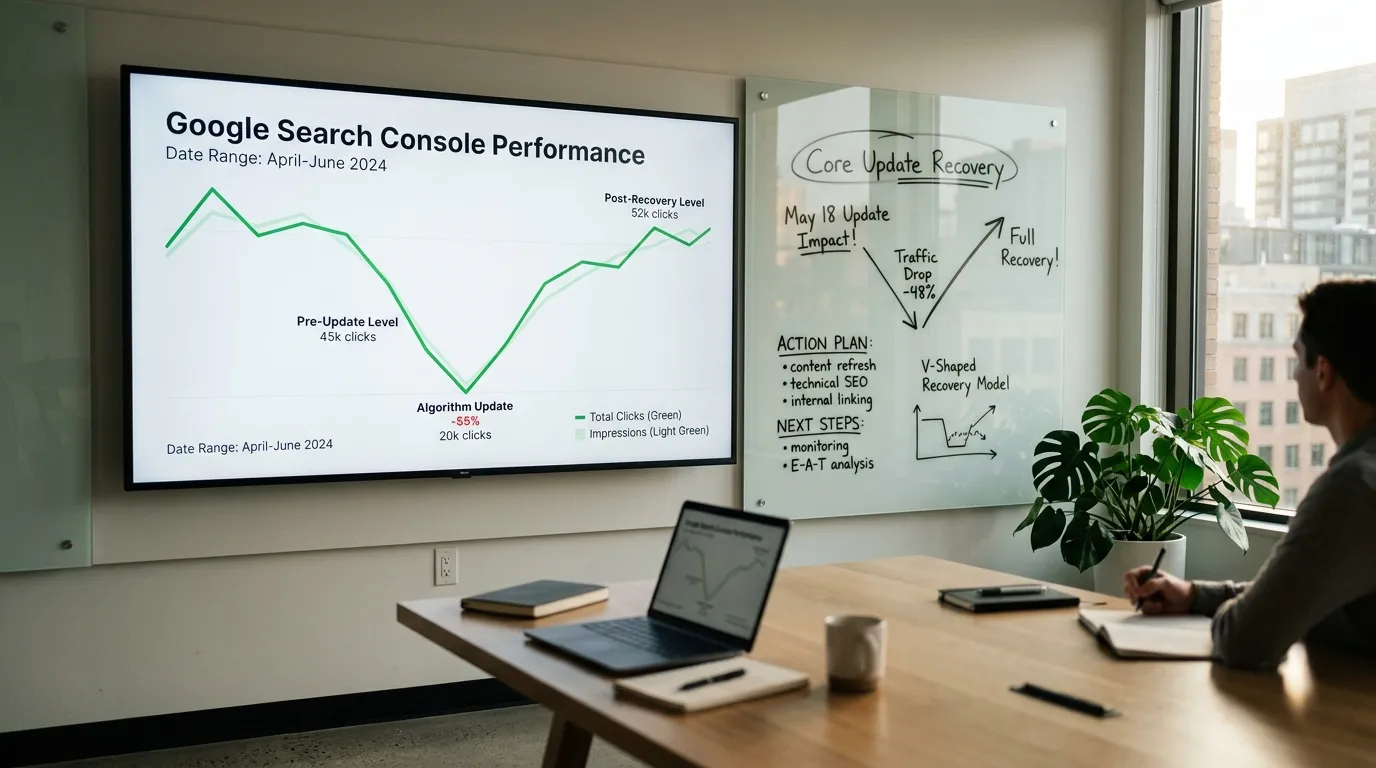
Key Takeaways
- Google’s March 2026 core update finished rolling out on 8 April 2026 after a 12-day cycle. There has been no officially named Google core update since, despite persistent ranking volatility through May.
- The recovery pattern is clear: sites with named authors, original data, and first-hand experience are recovering. Templated, affiliate-style and lightly-edited AI content is not.
- AI Overviews compound the problem. A site that recovered to position 1 may still see fewer clicks than before the update because the AI Overview above the result absorbs the click.
- Core Web Vitals signals were quietly tightened in May. Sites with INP (Interaction to Next Paint) issues are seeing extra ranking pressure that did not exist three months ago.
- The recovery playbook that is working: rewrite intros for AI extraction, demonstrate experience with real examples, fix technical health, add FAQ schema, kill thin pages. Surface-level author-bio fixes are not enough.
Google’s March 2026 core update finished rolling out 12 days after it began, completing on 8 April 2026 according to Google’s official status dashboard. Two months on, the dust has settled enough to see what actually happened. This post is a follow-up to our original analysis of the March and April 2026 core updates, looking at the recovery pattern across New Zealand accounts, what is actually moving in May, and what to do if your rankings are still down.
One important note up front. There is no officially named May 2026 core update. Several SEO publications have used the phrasing, but Google’s status dashboard records only the March 2026 core update, the March 2026 spam update, and the February 2026 Discover update for the year so far. What has been happening in May is a combination of post-update recovery, AI Overviews rollout (covered separately in AI Overviews Just Cut Click-Through Rates by 61%), and ongoing background algorithm tuning that Google does not announce.
1. What Google actually rolled out, and what it did not
For clarity, here is what Google has officially confirmed for 2026 to date:
- February 2026 Discover update. Rolled out 5-26 February, affecting Google Discover feed exposure rather than core search rankings.
- March 2026 spam update. Rolled out 24-25 March in a tight 19.5-hour window. Targeted scaled content abuse, expired-domain abuse, and PBN link networks.
- March 2026 core update. Rolled out 27 March to 8 April, the big one of the year so far. Broad ranking realignment focused on content quality, EEAT signals, and demoting intermediary content.
- AI Overviews May 2026 update. Rolled out from 6 May with new features in AI Overviews and AI Mode (Explore new angles, community perspectives, more inline source links, Gemini 3.5 Flash as default).
What has not happened: no officially named May 2026 core update, despite consistent ranking volatility through May. SEO tools show plenty of movement. Google has not labelled it.
2. The recovery pattern we are seeing in New Zealand accounts
Across the SEO accounts we work on, the recovery pattern from the March 2026 core update is consistent.
Recovering well:
- Pages with a named author, real photo, and real bio
- Content with original data, real client examples, or first-hand experience
- Pages where the question the user asked is answered in the first 100-150 words
- Service pages with clear local context, real testimonials, and case study links
- Sites that fixed Core Web Vitals issues before March
- Pages with FAQ schema and structured data correctly implemented
Not recovering:
- Generic “what is X” content that reads like every other “what is X” post on the topic
- Affiliate-style roundups without first-hand product testing
- Pages that summarise other pages without adding original insight
- Sites with thin programmatic content (city-pages, service-page templates) that swap the noun and call it new content
- AI-generated content shipped without serious editorial input
- Pages with persistent Core Web Vitals failures, particularly INP
This is not a surprise. Google’s own Helpful Content Update guidance from 2022 told us this would happen. The March 2026 update was the version of that guidance with enforcement teeth.
3. Why some “recovered” sites still get less traffic
Here is the twist that catches a lot of New Zealand business owners out. Position rankings have recovered on plenty of sites we work on. Traffic has not recovered in line with rankings.
The reason is AI Overviews. A page that ranks 1 with an AI Overview above it can lose 60% or more of its expected clicks compared to a page that ranks 1 with no AI Overview. The 2026 data shows organic CTR on AI Overview queries falling from 1.76% to 0.61%. The position is the same. The clicks are not.
For business owners staring at Search Console, this looks like a contradiction. Impressions are up year-over-year. Average position is stable or better. Clicks are down. That is exactly the AI Overview signature, and it is a separate problem from the core update.
The diagnostic test: pull a sample of your top 20 queries in Search Console. For each one, search the query in incognito. If an AI Overview appears, that query is exposed. If most of your top queries are exposed, the AI Overview is your biggest traffic problem regardless of how well you recover from the core update.
4. The quiet Core Web Vitals tightening
This is the unannounced shift in May. Across the accounts we monitor, Core Web Vitals thresholds appear to have been quietly tightened. The numbers in Search Console have not changed, but the ranking weight assigned to them has.
The metric to watch is INP (Interaction to Next Paint), which measures how quickly your site responds to user interactions like clicks and taps. Sites with INP scores in the “needs improvement” band (200-500ms) are seeing more ranking pressure than they did two months ago.
LCP (Largest Contentful Paint) and CLS (Cumulative Layout Shift) continue to matter, but they have been part of the ranking calculation for years. INP is newer, and the bar appears to have moved up.
Action: open Search Console, go to Experience > Core Web Vitals, and check both Mobile and Desktop tabs. If any URLs are listed under “Needs improvement” or “Poor”, they are now a higher priority than they were in March.
5. The recovery playbook that is actually working
For New Zealand businesses still seeing soft rankings, the recovery work that is actually producing results, in priority order:
1. Rewrite the opening paragraphs of your highest-value content for AI extraction.
The first 100-150 words of every blog post and service page now have to do three things: directly answer the question, signal authority (named author, brand, location), and be self-contained. Bury the lead, lose the AI Overview citation and the human reader.
2. Demonstrate experience with real examples.
Replace generic best-practice paragraphs with first-hand examples. “We saw X happen with a client in Auckland” beats “Most businesses see X” every time. This is the EEAT signal Google has been asking for since 2022, and the March 2026 update finally enforced it at scale.
3. Fix Core Web Vitals.
INP first, then LCP. Get every important page out of the “Needs improvement” band on mobile. This is now a higher-impact intervention than it was three months ago.
4. Add FAQ schema across service pages and blog posts.
Three to five questions per page, answered in plain English. Implement FAQPage schema. This serves two purposes: it improves AI Overview citation chances and it gives Google a structured way to read the page.
5. Kill thin pages.
If a page has under 300 words, is duplicative of another page on the site, or was created to target a thin keyword variation, either expand it into something genuinely useful or noindex it. Thin pages drag the rest of the site down with them.
6. Build internal links from pillar content.
Your strongest pages (most internal links pointing to them) should be pointing to the pages you want to rank for harder keywords. Internal linking is the cheapest, fastest signal you can add right now.
7. Earn external links from authority sources.
Backlinks still matter, the bar for what counts as a quality link has risen. Industry bodies, local press, supplier and partner mentions all carry weight. PBNs and link exchanges no longer do.
The free SEO Audit Checklist covers most of the technical and on-page items above in a self-audit format.
6. Specific signals we are tracking for New Zealand clients in May
Across active SEO accounts, the dashboard we are now watching weekly:
- Search Console impressions and clicks year-over-year, with a focus on the impressions / clicks ratio
- AI Overview presence on each client’s top 20 queries (manual check, fortnightly)
- Search appearance breakdown in Search Console (specifically the Featured Snippets and Rich Results rows)
- Core Web Vitals report, both Mobile and Desktop
- Top page-by-page click changes, focused on identifying which specific pages lost clicks rather than what the site-wide number looks like
The site-wide traffic number is the least useful of these. It hides where the wins and losses are happening.
7. What probably comes next
Best-guess outlook for the next two to three months, based on Google’s recent cadence and what has been signalled at I/O 2026:
- Expect a confirmed core update before the end of Q3. Google has run roughly four core updates per year for the last three years. The next one is likely in the July to September window.
- Continued AI Overviews expansion into New Zealand search. US coverage is around 50% of queries. New Zealand is still lower but the gap is closing fast.
- More structured data weight. AI Overviews and AI Mode rely on it. Sites that ignore it will be left out of citations.
- Tighter Core Web Vitals enforcement. The unannounced May tightening will probably become a confirmed update in coming months.
None of this is new strategy. It is the same EEAT-led, content-quality-led, technically-sound SEO that has been working since 2022. The difference is the speed at which weak content is now penalised.
What to do if your traffic is still down two months on
Quick diagnostic flow if your traffic dropped during the March update and has not recovered:
- Check Search Console year-over-year. Are impressions stable but clicks down? That is an AI Overviews problem. Are both down? That is a ranking problem.
- Pick the top 10 pages that lost the most clicks. Read them. Are they generic? Do they bury the answer? Do they lack a named author? Are they thin?
- Run those pages through PageSpeed Insights. What is the Core Web Vitals score? What is the INP?
- Check the search terms triggering AI Overviews. Pull your top 20 queries and search each in incognito.
- Decide: is this a content problem, a tech problem, an AI Overview problem, or all three?
The honest answer for most New Zealand accounts is all three. The good news is the work to fix them is well-defined and largely the same work, regardless of which is dominating.
Frequently Asked Questions
When did the March 2026 core update finish rolling out?
The March 2026 core update completed its rollout on 8 April 2026, 12 days after it began on 27 March. Google’s status dashboard confirms the full duration as 12 days, 4 hours.
Has Google announced a May 2026 core update?
No. Google has not officially confirmed a May 2026 core update. The most recent ranking-related updates on Google’s status dashboard are the March 2026 core update, the March 2026 spam update, and the February 2026 Discover update. Some SEO publications have written about a “May 2026 update”, but no Google announcement supports that framing.
How long does recovery from a Google core update take?
Per Google’s own core updates guidance, recovery typically takes one full core-update cycle, which historically has been three to four months. Sites that materially improve content quality, EEAT signals and technical health within that window tend to see recovery at the next update. Sites that do not, do not.
Will my rankings come back if I make the changes you recommend?
Some will, some will not. Recovery is more likely if the work is structural (rewriting intros, demonstrating experience, fixing technical issues) rather than cosmetic (adding an author bio without changing the underlying content). The honest answer is that some pages will need to be retired entirely if they cannot be made genuinely useful.
Is SEO still worth investing in given AI Overviews?
Yes, but the goal has shifted. The new objective is being cited inside the AI Overview as well as ranking. Sites that adapt their content for both human readers and AI extraction continue to perform well. Sites that ignore AI extraction in their content structure are losing traffic and will keep losing it.
Related reading
- Google’s March and April 2026 core updates explained (original analysis)
- AI Overviews just cut click-through rates by 61%
- Google Marketing Live 2026: what New Zealand advertisers need to know
- Free SEO Audit Checklist
- SEO Services: Lucid Media
If your rankings dropped during the March update and have not recovered, the diagnostic flow above will tell you which problem you actually have. The fix list is usually straightforward; the harder bit is committing to do it. We run SEO recoveries for New Zealand businesses. Book a free 30-minute strategy call and bring your Search Console along.
Sources: Google Search Status Dashboard, Ranking incidents · Google Search Central, Core Updates documentation

Written by
Jason Poonia
Jason Poonia is the founder and Managing Director of Lucid Media, helping New Zealand businesses grow online since 2018. With over 7 years delivering results for clients across New Zealand and internationally, Jason combines technical expertise with proven marketing strategies to help businesses attract more customers and build scalable systems. Background in Computer Science from the University of Auckland.