Do You Actually Need a Web Developer, or a Website Builder? (NZ Guide)
A clear decision framework for NZ businesses: when Squarespace, Wix or Shopify is genuinely enough, and when the complexity, stakes and growth of your business mean a web developer is worth the cost.
The short answer: it depends on complexity, stakes, and where your business is heading
Most NZ businesses do not need a web developer. A website builder like Squarespace, Wix or Shopify will do the job, cost less, and let you keep control. You genuinely need a developer when the complexity of what you are building, the stakes riding on the site, or the growth trajectory of the business pushes you past what a builder can do well.
That is the whole decision in one sentence. The rest of this guide is about working out which side of the line you sit on, honestly, without a sales pitch pushing you toward the more expensive option by default.
We build custom websites for a living, so it would be easy to argue that everyone needs a developer. That is not true, and pretending otherwise wastes your money. Plenty of the businesses we talk to would be better served spending a weekend on Squarespace than a five-figure sum on a custom build they do not yet need. The point of this article is to help you tell the difference.
What a website builder actually is (and what it is not)
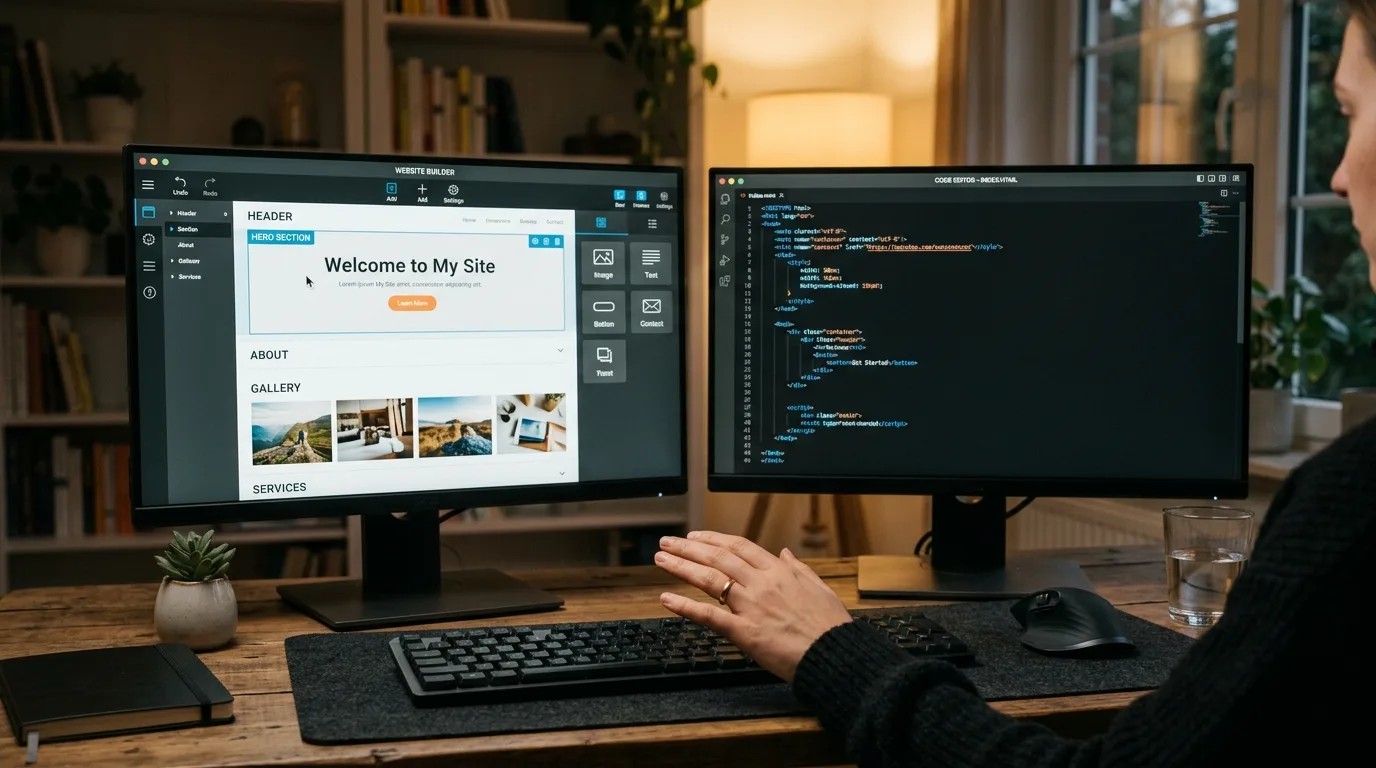
A website builder is a platform that lets you assemble a website yourself using drag-and-drop tools and pre-made templates, with hosting included. Squarespace, Wix, Shopify, WordPress.com and Webflow all fall into this category. You are not writing code, and you are not hiring anyone. You pay a monthly fee and you do the work.
A web developer is a person (or an agency) who builds a website, or the systems behind it, to your specific requirements. That can mean a custom-designed site on WordPress, a Shopify store with custom functionality a template cannot provide, or a fully custom web application. You are paying for someone else’s time, judgement and technical skill, not just software.
The confusion usually comes from treating this as a quality question, as if builders are amateur and developers are professional. It is not. It is a fit question. A well-run Squarespace site can comfortably outperform a badly briefed custom build. The right choice depends entirely on what your business actually needs the website to do.
When a website builder is genuinely the right call
A website builder is the right choice when your site is essentially a well-presented brochure, your requirements are standard, and your budget is better spent elsewhere. If most of the following describe you, stay on a builder and do not feel you are settling.
- Your site’s main job is to look credible, explain what you do, and give people a way to get in touch or book.
- You sell a manageable number of products or services that fit a standard structure.
- You do not need the website to talk to other systems in any complicated way.
- You are early enough that your offer, pricing and positioning are still moving around, and you need to be able to change things yourself, quickly, without booking developer time.
- Your budget is genuinely tight and every dollar has a job to do.
A tradesperson who needs to show up in local search, display their work, and take enquiries does not need a developer. Nor does a café, a personal trainer, a consultant, or a new online store testing whether people will buy at all. Modern builders handle mobile, basic contact forms, blogs and standard eCommerce out of the box. For these businesses, a builder is not a compromise. It is the correct tool.
There is a real hidden cost to the builder route, and it is honest to name it: your time. A business owner with no design background can lose many hours building and fiddling with a DIY site, and those are hours not spent selling or serving clients. But if the alternative is spending money you do not have on functionality you do not need, that time is usually the cheaper trade. We cover this in more depth in Is it worth paying someone to build a website? and Can a normal person make a website?.
When you genuinely need a web developer
You need a web developer when what you are building is beyond what a template can do, when the site is a primary revenue channel rather than a nice-to-have, or when the business is growing into requirements a builder cannot follow. Any single one of these can justify a developer. Together, they make the decision obvious.
Here are the specific triggers, and why each one pushes you past a builder.
The complexity trigger: your site needs to do something, not just say something
If your website needs to connect to other systems or run custom logic, you are past what most builders handle cleanly. Common examples for NZ businesses:
- A booking or quoting system that plugs into your calendar, availability and pricing rules.
- A connection to your CRM, accounting software or inventory system so data flows without manual re-keying.
- eCommerce logic that goes beyond simple products, such as bundles, subscriptions, complex shipping rules, trade pricing, or B2B wholesale accounts.
- An internal tool, calculator, portal or dashboard that customers or staff log into.
- Anything a template genuinely cannot represent, where you keep hearing “the platform does not support that.”
Builders are built around common cases. The moment your requirement sits outside the common case, you either bend your business to fit the tool, or you hit a wall. That is the point where a developer earns their fee, because custom functionality is exactly what a builder cannot give you. It is the core of what our web development work exists to do.
The stakes trigger: the website is how the business makes money
If your website is the primary way you generate leads or sales, small differences in performance become large differences in revenue, and that is where professional work pays for itself. A template is designed for broad appeal, not for your specific audience, offer and conversion goals. A developer working alongside a designer builds around how your particular customers make decisions, with page speed, technical SEO and conversion treated as first-class concerns rather than afterthoughts.
This is not a vague promise. We rebuilt a lead funnel for Fundmaster that reached a 10.44% landing page conversion rate. For an NZ furniture retailer we grew organic traffic by 298%, to the point where organic overtook paid as their main acquisition channel. When the site is the engine of the business, the gap between “looks fine” and “performs well” is measured in the leads and sales you either capture or lose. Over more than 100 projects since 2018, the pattern is consistent: the businesses that treat the website as a revenue asset are the ones for whom professional work returns the most.
If your website is a secondary channel and enquiries mostly come from referrals or word of mouth, this trigger does not apply to you, and you can weight the decision back toward a builder.
The growth trigger: where the business is heading, not just where it is
If you can see the business outgrowing a builder within a year or two, it is often cheaper to build for that now than to migrate later. Signs you are on this path:
- You are hiring, adding locations, or expanding into new markets, and the website needs to keep up.
- You are moving from a handful of products to a real catalogue, or from one service to a structured range.
- You keep adding manual workarounds to make the builder do things it was not designed for, and the workarounds are piling up.
- You are starting to compete in search against businesses with far more technical firepower, and the builder’s SEO ceiling is holding you back.
The trap here is the false economy of the migration. We regularly meet NZ owners who built on a free or entry-level builder, fought it for six months to a year, then hired a developer anyway. The total cost by then is always higher than starting with the professional build would have been, because you pay once to outgrow the builder and again to rebuild. If the growth is genuinely coming, factor the rebuild you are deferring into today’s decision.
A five-question decision framework
Run your situation through these five questions. There is no scoring trick here. If you answer yes to even one or two of the first four, a developer is likely worth serious consideration. If you answer no across the board, a website builder is almost certainly the right call.
- Does the site need to do something custom? Connect to other systems, run its own logic, or offer functionality a template genuinely cannot. If yes, lean developer.
- Is the website a primary revenue channel? If most of your leads or sales depend on it converting well, lean developer. If it is a supporting brochure, lean builder.
- Will the business outgrow a builder within a year or two? If the growth is real and visible, lean developer to avoid paying twice. If you are testing or steady, lean builder.
- Do you need control a builder cannot give you? Technical SEO depth, custom performance work, or design that is built around your customers rather than a template. If competitive search or conversion matters, lean developer.
- Is your budget better spent elsewhere right now? If the honest answer is yes, and the four questions above did not raise red flags, a builder is the responsible choice. Put the money into the part of the business that needs it most.
The framework is deliberately weighted toward not spending money you do not need to spend. A developer is worth it when the complexity, stakes or trajectory make it worth it, and not as a default upgrade because custom sounds more serious.
The honest middle ground most guides skip
There is a third option between “do it all yourself” and “commission a full custom build,” and it suits a lot of NZ businesses: a professional working on a builder platform. A developer or designer can build a custom-designed Shopify store, a properly structured WordPress site, or a Webflow site that looks and performs far better than a DIY effort, while still keeping you on a platform you can update yourself afterward.
This is often the right answer when your stakes are high but your complexity is low. You get professional design, real SEO groundwork and a site built to convert, without paying for custom functionality you do not need. You keep the ability to change your own content without booking developer time. For a business that is serious about results but not running complex systems, this middle path frequently beats both extremes.
The point is that “builder versus developer” is not actually a binary. The real question is how much professional input each part of your project needs, and where your money creates the most return.
What it costs, roughly, and why the numbers vary so much
Website builder subscriptions in New Zealand typically run at a modest monthly fee, with the entry paid tiers being far better value than the free plans once you factor in a custom domain and the removal of platform branding. A professionally built custom website is a different order of investment, and the range is wide because “a website” can mean a five-page brochure or a custom web application, and those are not remotely the same job.
We keep our pricing framed as ranges and market observations rather than a fixed number, because a real quote depends on scope. But the principle holds: the more custom functionality, integration and performance work involved, the higher the cost, and the more the return depends on the site actually being a revenue driver. For a fuller breakdown, see our guides on how much it costs to design a website in NZ and a reasonable price for a website in NZ.
The way to judge the spend is return, not sticker price. If a well-built site wins you even one additional client a month, and that client is worth a meaningful amount over their lifetime, the maths on a professional build changes quickly. If the site is a supporting brochure that rarely drives a decision, that same spend is hard to justify, and a builder is the smarter call.
Frequently asked questions
Do I need a web developer or can I use Squarespace?
For a standard brochure or small business site, Squarespace is usually enough and you do not need a developer. You need a developer when the site has to connect to other systems, run custom functionality a template cannot handle, or is the primary channel your revenue depends on. If your requirements are standard and your budget is tight, Squarespace or a similar builder is the sensible choice.
Is Shopify enough, or do I need a developer for an eCommerce site?
Shopify on its own handles most standard online stores well, so for a straightforward catalogue you often do not need a developer. You need one when you require functionality beyond standard products, such as subscriptions, complex shipping or trade pricing, B2B wholesale accounts, or integrations with your inventory or accounting systems. Many stores start on standard Shopify and bring in a developer later as their requirements grow.
What is the difference between a website builder and a web developer?
A website builder is software you use yourself to assemble a site from templates, with hosting included, such as Wix, Squarespace or Shopify. A web developer is a person or agency who builds a site or system to your specific requirements. The builder route trades your time and some flexibility for a low cost. The developer route trades a higher cost for custom functionality, professional design and performance work you cannot get from a template alone.
Is it cheaper to build my own website?
Building your own site on a builder is cheaper in dollars, but the true cost includes your time and any revenue a better-performing site would have captured. For a supporting brochure site, DIY is often the genuinely cheaper option overall. For a site the business relies on to generate leads or sales, the money saved by building it yourself can be lost several times over in weaker conversion and search performance.
When is a website builder a mistake?
A website builder becomes a mistake when your business has clearly outgrown it and you keep bolting on manual workarounds to make it cope. The common pattern is building on a builder, fighting it for six months to a year, then hiring a developer anyway, which costs more in total than starting with the professional build. If you can already see that growth coming, factor the eventual rebuild into your decision now.
Can a developer just improve my existing builder site instead of rebuilding it?
Often, yes. A professional can work on a builder platform, improving design, structure, SEO groundwork and conversion without moving you off the platform you already use. This middle ground suits businesses with high stakes but low complexity, because you get professional input where it matters while keeping the ability to update your own content. A full rebuild only becomes necessary when the platform itself cannot support what you need.
Where to go from here
Start by being honest about which side of the line you are on. If your site is a well-presented brochure, your requirements are standard, and your budget has better uses, a website builder is the right answer and you should not let anyone talk you out of it. If your site needs to do something custom, carry real revenue weight, or keep pace with a growing business, a developer is where your money earns its return.
If you are weighing up a build and want a straight assessment of which route actually fits your situation, take a look at our web development service or book a discovery call. We would rather tell you a builder is enough than sell you a custom site you do not need yet.
Related posts

Written by
Jason Poonia
Jason Poonia is the founder and Managing Director of Lucid Media, helping NZ businesses grow online since 2018. With over 7 years delivering results for clients across New Zealand and internationally, Jason combines technical expertise with proven marketing strategies to help businesses attract more customers and build scalable systems. Background in Computer Science from the University of Auckland.