
Shopify Collection Pages vs Product Pages: Where NZ Stores Lose SEO the Most
Why collection pages carry more buyer-intent search volume than product pages on Shopify, and what a good vs bad collection page actually looks like.
The short answer
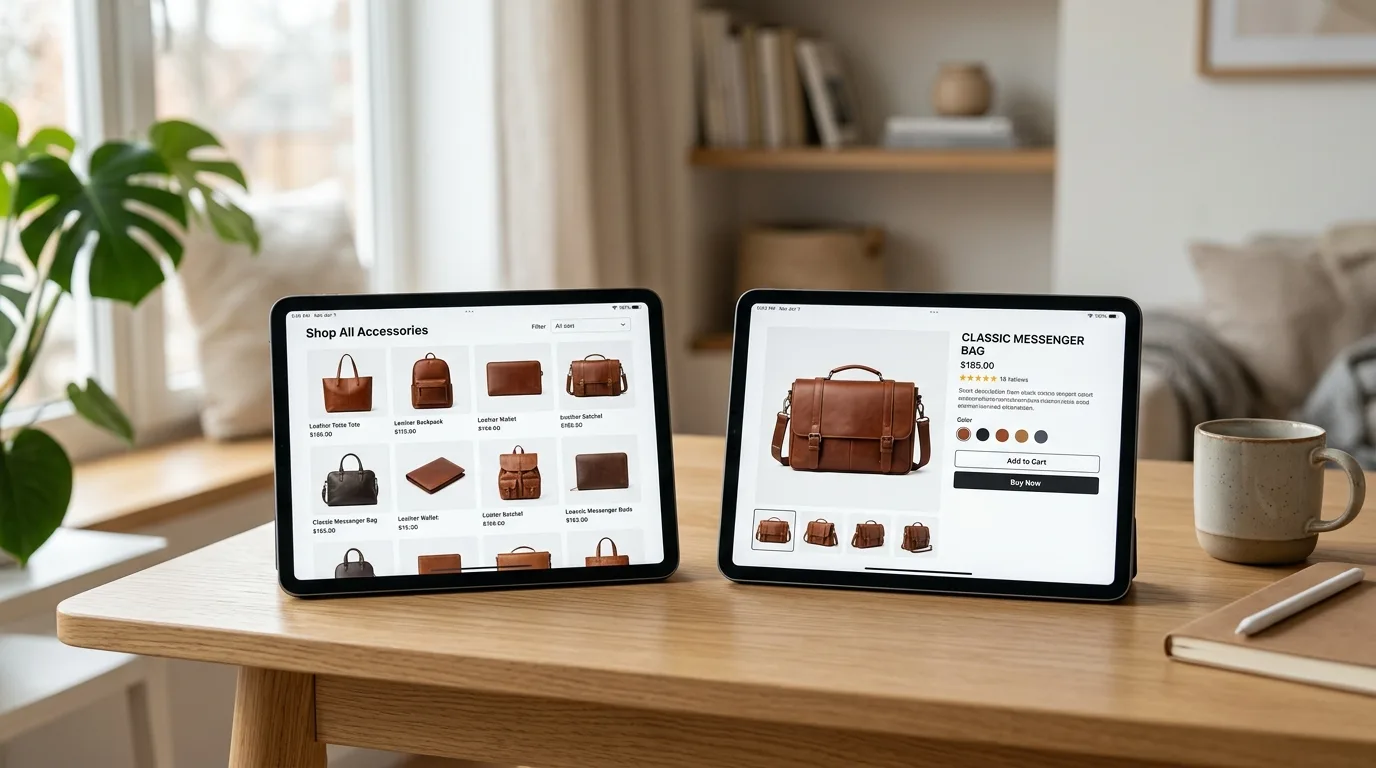
Collection pages, not product pages, are where most NZ Shopify stores are leaving organic traffic on the table. Product pages target narrow, specific searches (“[brand] [exact product name]”), while collection pages target the broader, higher-volume category searches shoppers actually type first, things like “wool rugs nz” or “men’s running shoes”. Most Shopify themes ship with thin, templated collection pages and put all the SEO effort into individual products. That’s backwards from where the search demand actually sits.
This post breaks down the structural difference between the two page types on Shopify specifically, why collection pages get neglected, and what separates a collection page that ranks from one that doesn’t.
Why collection pages and product pages need completely different SEO treatment
A product page and a collection page are answering different questions, so they need different content, different keyword targeting, and different technical handling. Treating them as the same problem is the root cause of most collection-page underperformance.
A product page exists to convert someone who already knows roughly what they want. The searcher has typically moved past browsing and is comparing specific items, checking a specific model, or looking for a specific SKU. Search intent here is narrow and often branded: “[product name] nz”, “[product name] review”, “[product name] price”.
A collection page exists to catch someone earlier in the journey, when they know the category but haven’t picked a product yet. This is where most of the actual search volume lives, because far more people search “waterproof hiking boots nz” than search any single boot’s exact name. Collection pages need to answer a broader question: what are my options, which one fits me, and why should I trust this store to sell it to me.
On Shopify specifically, this distinction matters more than on other platforms because of how the platform structures URLs and templates. Every collection page uses the same collection.liquid (or newer JSON template) by default, which means unless a store actively customises it, every category on the site looks and reads identically: a title, a filter bar, and a grid of products. Product pages get individual attention because merchandisers are already writing product descriptions for the sales copy. Collection pages get none of that manual care, so they default to whatever the theme generates, which is usually close to nothing.
Why NZ Shopify stores under-invest in collection pages
NZ stores under-invest in collection pages because the theme makes them easy to ignore, and because collection-level content isn’t obviously required to make a sale. A product page has to exist and has to have basic content, or the product simply doesn’t display properly. A collection page will function and let customers filter and buy with zero unique content on it at all. Nothing breaks if you skip it, so most stores do.
There are three specific reasons this shows up more in NZ stores than in bigger international ones:
Small teams, and collection pages read as “just a category filter”. Most NZ Shopify merchants are running lean, often a founder or one marketing hire managing the whole store. Writing unique copy for twenty product pages already feels like a lot of work. Writing copy for collection pages on top of that, when the collection page “already has products on it”, doesn’t feel urgent. It’s the classic case of investing where the work is visible (the product listing) rather than where the traffic actually is (the category search).
Theme defaults train merchants to think collection pages don’t need content. Most Shopify themes place the collection description, if there’s a field for it at all, in a small text box above the product grid that’s easy to leave blank or fill with a single generic sentence. Nothing in the default theme experience nudges a merchant toward treating that space as a real page.
Collection URLs and titles are often auto-generated and never revisited. A collection created as “New Arrivals” or “Sale” is a fine merchandising label but a poor SEO target, since almost nobody searches those terms. Meanwhile the collection that should be ranking for the actual buyer-intent term (the category name people search) either doesn’t exist as its own collection, or exists with a generic, unoptimised title and meta description that was never touched after the store was set up.
The result is a strange mismatch: the pages carrying the most search-volume potential (collections) get the least SEO investment, while the pages carrying the most SEO investment (individual products) target much smaller, narrower keyword pools.
What a bad Shopify collection page looks like
A bad collection page is functionally just a product grid with a heading on top. Here’s what that tends to look like in practice:
- Title is the raw collection name with no context. “Rugs” instead of something that matches how people actually search, like “wool rugs nz”.
- No collection description, or one throwaway sentence. Something like “Shop our range of rugs.” that says nothing a search engine (or a shopper) can use to understand what makes this range worth buying from.
- No H1 distinct from the page title, or the H1 duplicates the exact nav label with zero descriptive value.
- Meta title and meta description left on Shopify’s auto-generated default, which is usually just the collection name repeated, sometimes truncated mid-word.
- Zero internal linking context. No links to related collections, no links out to guide-style blog content, nothing connecting the category to the rest of the site’s content.
- Filtering and sorting parameters generate indexable duplicate URLs.
?sort_by=price-ascendingand similar filter combinations get crawled and indexed as separate pages with identical or near-identical content to the main collection, diluting the ranking signal that should be consolidated on one URL. - No FAQ or buying-guidance content, despite the category being exactly the place a shopper would have comparison questions (sizing, material differences, which option suits which use case).
- No structured data, so the collection can’t appear with rich results and gives search engines less context about what’s actually being sold there.
Individually, none of these look like a big deal. Together, they mean the page has almost nothing for Google to differentiate it from every other generic category page on every other Shopify store selling the same kind of product. There’s no reason for it to outrank a competitor’s collection page, because there’s nothing on it that couldn’t apply to any store.
What a good Shopify collection page looks like
A good collection page reads like a genuinely useful category hub, not a product grid with a label. The core differences:
- The title and H1 match how people actually search, not just the internal merchandising name. “Wool rugs NZ” rather than “Rugs”, if that’s the actual buyer-intent phrase.
- A real collection description above or below the product grid, written for the category as a whole: what the range covers, how the options differ (by material, size, use case, price point), and what to consider when choosing. This is also the natural place to work in the category’s genuine buyer-intent keywords without it reading like keyword stuffing, because it’s answering a real question a shopper has.
- Clear, sensible subcategory or filter structure that doesn’t generate indexable duplicates. Canonical tags pointing filtered/sorted URL variants back to the main collection URL, so link equity isn’t split across a dozen near-identical pages.
- A unique, specific meta title and meta description, written to match search intent rather than left on the Shopify default.
- Internal links out to related collections and to relevant blog or guide content, and links in from those same places. If the store has a buying-guide post relevant to the category, that post should link to the collection, and the collection should link back.
- An FAQ section addressing genuine pre-purchase questions for that category (sizing, care instructions, which variant suits which need), written to directly answer the question in the first line, because this is exactly the kind of content that gets surfaced in search snippets and AI-generated answers.
- Structured data (ItemList / Product schema) implemented at the collection level, giving search engines explicit signals about what the category contains.
- Genuine editorial framing, not filler. The goal isn’t to pad the page with generic paragraphs for the sake of word count. It’s to make the page a real answer to “what are my options in this category and how do I choose”, which happens to be exactly what both shoppers and search engines are looking for.
None of this is exotic. It’s the same content discipline most stores already apply to their homepage and their best product pages, just extended to the category level where the search volume actually sits.
How this plays out on a real Shopify store
Consider a NZ homeware store selling rugs. It has product pages for “Kilim Wool Runner 80x300cm” and “Moroccan Style Jute Rug”, both reasonably well optimised with photos, descriptions, and reviews. Those pages can realistically compete for searches like the exact product name, plus maybe a handful of long-tail combinations.
But almost nobody searches “Kilim Wool Runner 80x300cm” unless they already know the store. Far more people search “wool rugs nz” or “jute rugs nz”, and that’s precisely the search volume the store’s “Rugs” collection page is supposed to be capturing. If that collection page is just a grid with a one-line description, it’s competing against every other retailer’s collection page on a level playing field of “basically no content”, and ranking becomes a function of raw domain authority rather than relevance. If instead that collection page has a genuine, useful description of the range, clear guidance on choosing between wool and jute, an FAQ, and clean technical handling of filter URLs, it has something a generic competitor page doesn’t: a real reason for Google to consider it a better answer to the search.
This is also where SEO work compounds with CRO rather than working against it. A well-written collection description that answers “which of these should I buy” doesn’t just help rankings, it helps the shopper who lands there make a decision instead of bouncing back to search. The same content investment serves both goals.
Where to start if collection pages have been neglected
Start with the collections that already carry meaningful organic traffic or impressions in Search Console but rank outside the top few positions. These are the pages closest to a breakthrough, where a content and technical upgrade is most likely to show movement rather than pages starting from nothing.
For each priority collection: check what the actual buyer-intent search term is (not the internal collection name), rewrite the title and meta description to match it, add a genuine collection description, fix duplicate indexing from filter parameters with canonical tags, and add an FAQ block addressing real pre-purchase questions for that category. Then link it properly, both from related collections and from any existing blog content that’s relevant.
This is slower than optimising a single product page, because a collection page touches merchandising structure, not just copy. But it’s usually the change that moves the needle most, because it’s addressing the page type that was carrying the most unclaimed search volume in the first place.
Frequently asked questions
Do collection pages need more SEO work than product pages on Shopify? For most NZ stores, yes. Collection pages typically target broader, higher-volume buyer-intent searches (the category name), while product pages target narrower, lower-volume searches (the specific item name). Since Shopify’s default theme templates give collection pages almost no unique content out of the box, they tend to be the more under-optimised page type and often have more room to improve.
Why do Shopify collection pages create duplicate content issues?
Filtering and sorting options (like ?sort_by= or ?filter.v.option= parameters) generate separate, crawlable URLs that show largely the same products as the main collection page. Without canonical tags pointing those variants back to the primary collection URL, search engines can end up splitting ranking signals across several near-identical pages instead of consolidating them on one.
What should a Shopify collection page description actually include? A useful collection description explains what the range covers, how the main options differ from each other (by material, size, price point, or use case), and what a shopper should think about when choosing between them. It should be written to genuinely help someone decide, not simply repeat the category name for keyword density.
How long does it take to see ranking improvement after fixing a Shopify collection page? It varies by how competitive the category is and how established the domain already is, and there’s no fixed timeframe that applies to every store. In general, technical fixes like canonicalising duplicate filter URLs tend to show up in crawling and indexing behaviour before content changes influence rankings, and both need time for search engines to re-crawl and re-evaluate the page.
Should every Shopify collection have its own unique page, or can some be combined? It depends on whether each collection maps to a genuine, distinct search term. A collection that exists purely as an internal merchandising label, like “New Arrivals” or “Staff Picks”, isn’t targeting real buyer-intent search volume and doesn’t need the same SEO investment as a collection built around a category shoppers actually search for, like a specific product type or material.
If your Shopify store’s product pages are solid but the category-level traffic still isn’t showing up in Search Console, the collection pages are usually where to look first. For a broader look at how organic and paid channels should work together across an NZ e-commerce store’s calendar, see our e-commerce marketing calendar and ROAS benchmarks posts.

Written by
Jason Poonia
Jason Poonia is the founder and Managing Director of Lucid Media, helping NZ businesses grow online since 2018. With over 7 years delivering results for clients across New Zealand and internationally, Jason combines technical expertise with proven marketing strategies to help businesses attract more customers and build scalable systems. Background in Computer Science from the University of Auckland.