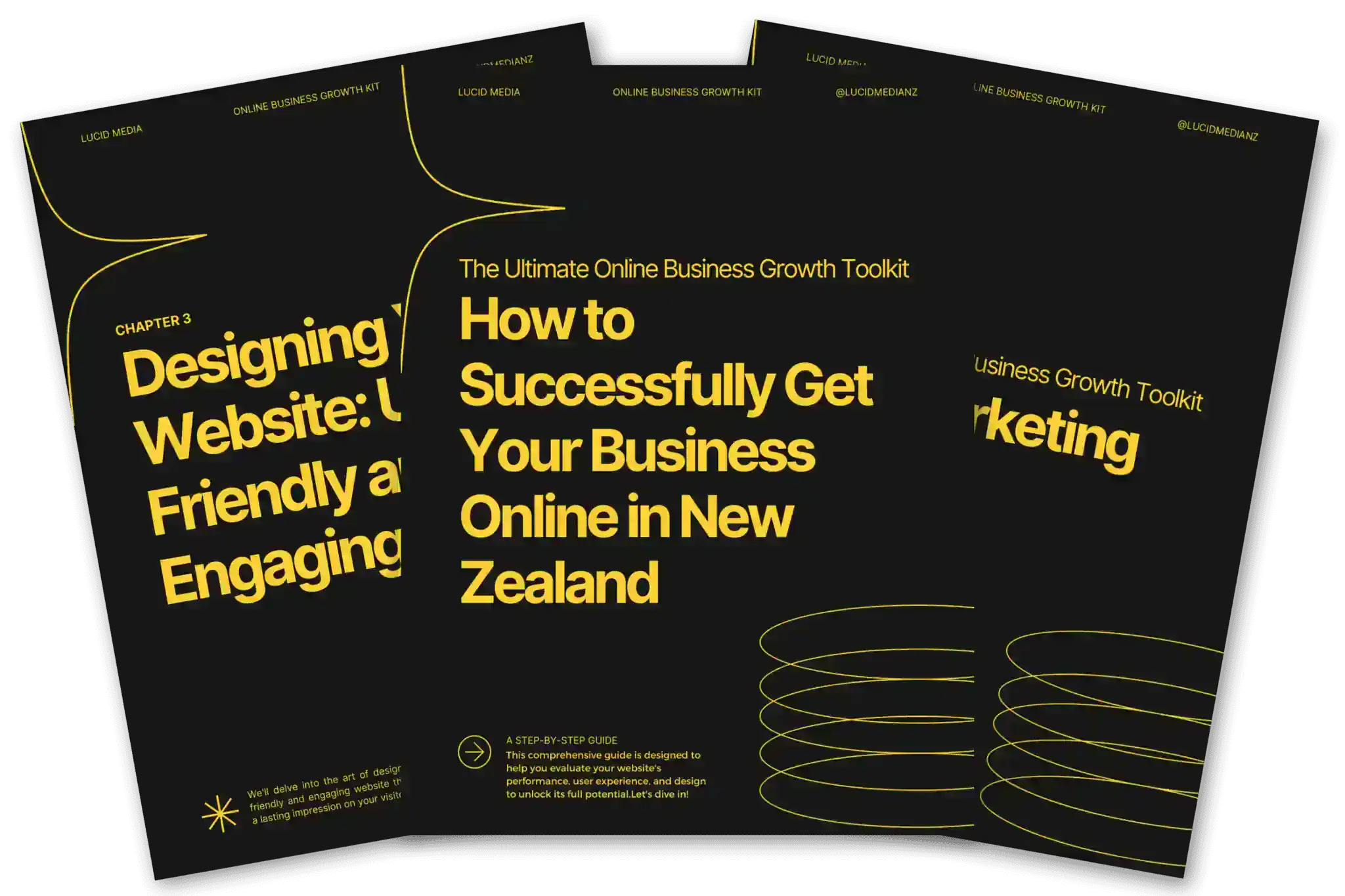
What to Include on Your Business Website in New Zealand
A complete checklist of what every NZ business website needs: contact info, service pages, pricing, social proof, mobile design, and local trust signals.

Key Takeaways
- Your phone number belongs in the header, not the footer, and every page needs a clear call to action.
- Create individual pages for each service or product category to target specific search terms and rank higher.
- Pricing guidance (even rough ranges) helps visitors qualify themselves before contacting you.
- Social proof like Google reviews, video testimonials, and client logos builds trust with naturally skeptical Kiwi customers.
- Mobile-friendly design, fast loading speeds, and HTTPS security are non-negotiable technical requirements.
- Display NZ-specific details like service areas, NZBN, and local payment options to build credibility.
We review a lot of business websites. The same gaps appear constantly. Pages that should exist don’t. Information customers need is buried or missing entirely. Basic trust signals are nowhere to be found.
Here’s what your New Zealand business website actually needs to include, based on what we see working (and failing) across hundreds of sites.
The Non-Negotiables
Clear Contact Information
Sounds obvious. Yet we regularly see businesses hiding their phone number in the footer, or worse, only offering a contact form.
Your contact details should include:
- Phone number (clickable on mobile)
- Email address
- Physical address if you have premises customers visit
- Operating hours, including what happens outside those hours
Put your phone number in the header. Not the footer. People on mobile shouldn’t have to scroll to the bottom of your homepage to call you.
What You Actually Do
Visitors should understand what your business offers within 5 seconds of landing on your homepage. This means:
- A clear headline stating what you do and who you help
- Subheadline expanding on that with specifics
- No jargon, no “solutions,” no “leveraging synergies”
“Auckland Commercial Cleaning” is clear. “Integrated Facility Hygiene Solutions Provider” is not.
Service or Product Pages
One page per major service or product category. Not a single page with a bullet list of everything you offer.
Why this matters: people search for specific services. “commercial kitchen cleaning Auckland” is a search term. “cleaning services” is too broad to rank for. Individual pages let you target specific searches and explain each service properly.
About Page That Builds Trust
The About page is often the second-most visited page on a business website. People want to know who they’re dealing with.
Include:
- How long you’ve been in business
- Who founded the company and why
- Photos of actual people (not stock photos)
- What makes you different from competitors
- Any relevant qualifications, certifications, or memberships
Nobody cares that you’re “passionate about delivering excellence.” They care that you’ve been doing this for 15 years and know what you’re talking about.
What Most Businesses Are Missing
Pricing Information
“But our pricing depends on the project!” Sure. But giving people zero guidance means they assume you’re expensive and leave.
Options that work:
- Starting-from prices (“Websites from $3,500”)
- Pricing ranges (“Most projects fall between $X and $Y”)
- Package pricing where applicable
- At minimum, factors that affect pricing
People searching for services want to know if you’re roughly in their budget before they contact you. Help them qualify themselves.
Social Proof
Testimonials, reviews, case studies, client logos. Evidence that other people have trusted you and been happy with the result.
Best options:
- Google reviews (linked or embedded)
- Video testimonials from real customers
- Case studies showing specific results
- Logos of recognisable clients (with permission)
Weakest option: anonymous text quotes (“Great service!” - J.S., Auckland). These look fabricated even when they’re real.
Frequently Asked Questions
The questions you answer on every sales call should be answered on your website. This:
- Saves you time on repetitive conversations
- Shows you understand customer concerns
- Provides content Google can index
- Addresses objections before people even ask
Don’t make them generic. “What areas do you service?” is useful. “Why should I choose you?” is not.
A Clear Next Step
Every page should tell visitors what to do next. This is your call to action.
- Service pages: “Get a quote” or “Book a consultation”
- Blog posts: “Want help with this? Contact us” or “Related services”
- About page: “Ready to work together? Here’s how to start”
If you don’t tell visitors what to do, they’ll do nothing.
NZ-Specific Considerations
Location Clarity
New Zealand is small but spread out. Make it immediately clear:
- Which regions or cities you service
- Whether you’re Auckland-only or nationwide
- If you service rural areas
- Whether you travel to customers or they come to you
A Wellington customer won’t contact an Auckland business for local services. Don’t make them guess where you’re based.
NZ Business Registration
Displaying your NZBN or company number signals legitimacy. It’s not required, but it helps establish trust, especially for businesses people haven’t heard of.
Local Payment Options
If you sell online, mention that you accept NZ payment methods. “We accept Visa, Mastercard, and POLi” is more relevant than talking about payment processors that don’t operate here.
Technical Basics
Mobile-Friendly Design
Over 60% of web traffic is mobile. Your site must work properly on phones:
- Text readable without zooming
- Buttons large enough to tap
- No horizontal scrolling
- Fast loading on mobile data
Test it yourself on your phone. If anything is frustrating, fix it.
Fast Loading Speed
Aim for under 3 seconds load time. Slow sites lose visitors and rank lower in Google.
Common culprits:
- Uncompressed images
- Too many plugins
- Cheap hosting
- Excessive animations or videos
Run your site through Google PageSpeed Insights. It’ll tell you exactly what’s slowing you down.
Security Certificate (SSL)
Your site needs HTTPS, showing the padlock icon. Without it:
- Chrome warns visitors your site is “not secure”
- You’ll rank lower in Google
- Customers won’t trust entering their details
Most hosting includes free SSL certificates. There’s no excuse not to have one.
What You Can Skip
Things that used to be standard but often aren’t necessary now:
Mission statement on homepage: Unless it’s genuinely compelling, it’s wasted space. Show what you do, not corporate-speak about values.
Separate news/blog if you won’t update it: An empty blog or “latest news” from 2023 looks worse than no blog at all.
Social media links if you’re not active: Linking to a Facebook page with 47 followers and no posts since March doesn’t help.
Image sliders/carousels: Studies show people ignore these. Use that space for something useful.
Reviewing Your Current Site
Open your website in an incognito window. Pretend you’re a customer who’s never heard of your business.
- Can you tell what they do within 5 seconds?
- Can you find contact details easily?
- Do you trust this business based on what you see?
- Is the next step clear?
If you answered no to any of these, those are your priorities.
Need an outside perspective? We offer free website audits for NZ businesses. We’ll tell you exactly what’s working, what’s missing, and what to fix first.

Written by
Jason Poonia
Jason Poonia is the founder and Managing Director of Lucid Media, helping NZ businesses grow online since 2018. With over 7 years delivering results for clients across New Zealand and internationally, Jason combines technical expertise with proven marketing strategies to help businesses attract more customers and build scalable systems. Background in Computer Science from the University of Auckland.