
10 Signs Your NZ Business Website Needs a Redesign (And What It Costs)
Is your website costing you customers? 10 warning signs it needs a redesign, plus realistic NZ pricing for 2026.
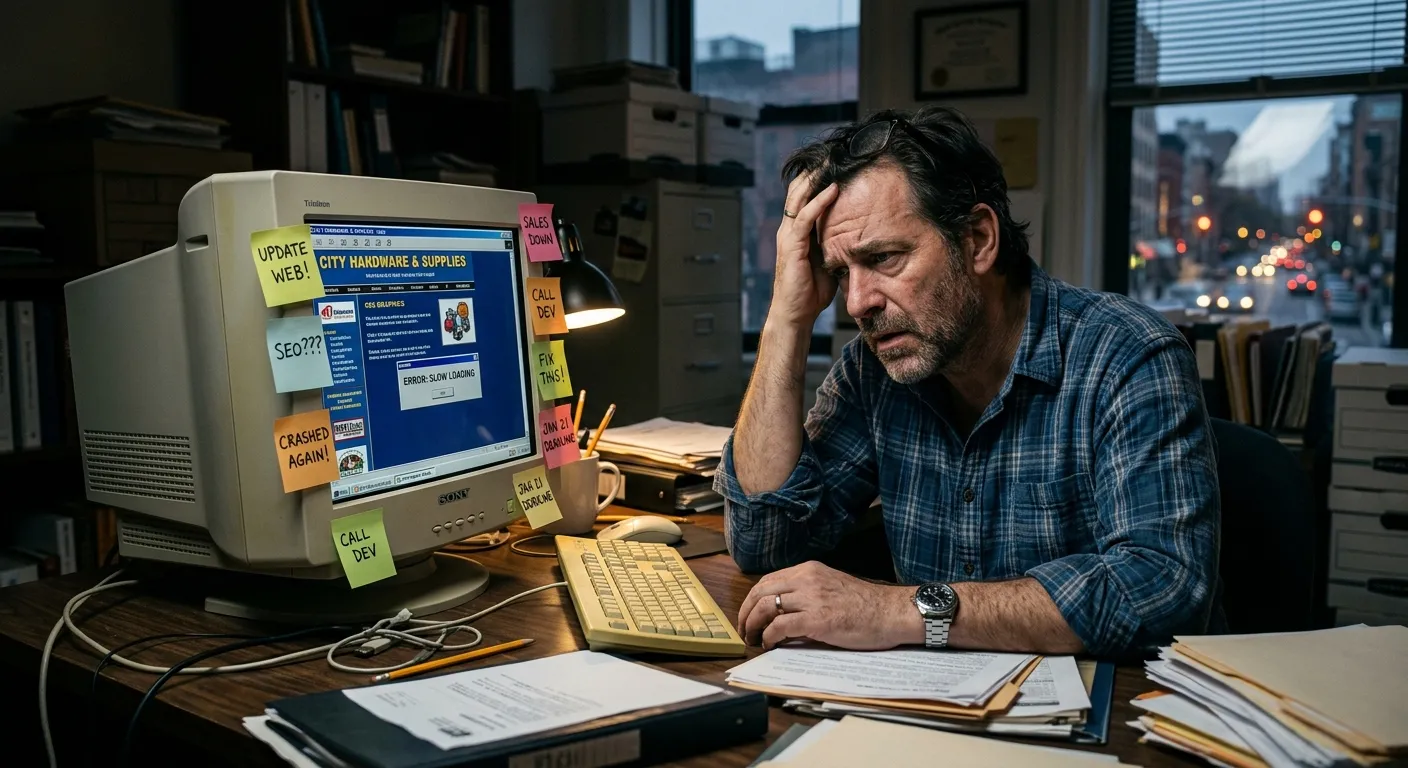
Key Takeaways
- Slow load times (over 3 seconds), poor mobile responsiveness, and outdated visual design are the three most damaging website problems for NZ businesses in 2026.
- A high bounce rate (above 60% for most industries) is a clear signal that visitors are arriving at your site and immediately deciding it is not worth their time.
- If your website does not generate consistent leads or enquiries, the problem is almost always the site itself rather than a lack of traffic.
- Security issues like missing SSL certificates do not just put your customers at risk. Google actively penalises unsecured sites in search rankings.
- A full website redesign in New Zealand typically costs between $5,000 and $20,000 depending on complexity, with most small business redesigns falling in the $5,000 to $12,000 range.
- Redesigning proactively based on performance data is always more cost-effective than waiting until your website becomes a genuine liability.
Your website is often the first interaction a potential customer has with your business. And unlike a face-to-face meeting where you can compensate with personality and expertise, your website has about three seconds to make an impression before that visitor clicks the back button.
The challenge is that website problems tend to creep in gradually. What looked modern three years ago now feels dated. Performance slowly degrades as plugins accumulate. Mobile traffic increases but your site was designed for desktop first.
Here are ten signs that your NZ business website needs a redesign, and what you can expect to invest in getting it right.
1. Your Website Takes More Than 3 Seconds to Load
Page speed is no longer optional. Google uses it as a ranking factor, and research consistently shows that 53% of mobile visitors abandon sites that take longer than three seconds to load. Every second of delay costs you customers.
Test your site with Google PageSpeed Insights. If your mobile score is below 50, you have a serious problem. If it is below 70, there is significant room for improvement.
Sometimes speed issues can be fixed without a full redesign through image optimisation, caching, and hosting upgrades. But if your site is built on bloated code with dozens of unnecessary plugins, a clean rebuild is often the most efficient path forward.
2. Your Site Is Not Mobile Friendly
In 2026, over 55% of New Zealand web traffic comes from mobile devices. For some industries, particularly trades and hospitality, that figure is above 70%. If your website does not work seamlessly on a phone, you are alienating the majority of your visitors.
Mobile-friendly does not just mean your site shrinks to fit a smaller screen. It means buttons are large enough to tap, text is readable without zooming, forms are easy to complete on a touchscreen, and navigation is intuitive on a small display.
Google also uses mobile-first indexing, which means it primarily evaluates the mobile version of your site for search rankings. A poor mobile experience directly hurts your visibility.
3. Your Bounce Rate Is Uncomfortably High
Bounce rate measures the percentage of visitors who land on your site and leave without taking any further action. While acceptable rates vary by industry, a bounce rate consistently above 60% is a warning sign.
High bounce rates typically indicate one or more problems: slow loading, poor design that undermines trust, irrelevant content for the visitor’s intent, confusing navigation, or aggressive pop-ups that drive people away.
Check your Google Analytics 4 engagement rate (the inverse of bounce rate) to understand how your pages are performing individually. Often, a few problem pages drag down your overall numbers.
4. Your Design Looks Outdated
Web design trends evolve, and visitors notice. If your site still uses stock photos with obvious watermarks, clip art style graphics, tiny text, cluttered layouts, or design elements that were popular in 2018, it creates an instant impression of a business that is behind the times.
This matters more than aesthetics. An outdated-looking website erodes trust. Visitors subconsciously think: if this business has not maintained their website, are they maintaining the quality of their services?
Look at your top three competitors’ websites. If their sites look significantly more professional and modern than yours, you are losing business to that perception gap.
5. Your Website Does Not Generate Leads
This is the ultimate test. If your website receives traffic but does not generate consistent enquiries, form submissions, phone calls, or sales, something is fundamentally broken.
Common culprits include weak or missing calls to action, no clear value proposition, poor positioning against competitors, buried contact information, and overly complex forms. Sometimes the content simply does not address what your target customer actually cares about.
A website that gets 500 visitors per month but produces zero leads is not a functional business tool. It is an expensive online brochure that nobody reads.
6. Your Competitors’ Websites Look Better
This is not about vanity. When a potential customer is comparing three businesses, the one with the most professional, trustworthy-looking website has a significant advantage. People judge credibility based on appearance, and your website is your digital shopfront.
Spend twenty minutes reviewing competitor websites. Note their design quality, the clarity of their messaging, how easy it is to take the next step, and the overall impression they create. Be honest about where your site falls in that comparison.
If you are consistently losing to competitors who are not necessarily better at what you do but simply present themselves more effectively online, a redesign becomes a revenue decision rather than a cosmetic one.
7. You Cannot Update Your Own Content
If making simple changes to your website requires a developer, your site is holding your business back. Modern content management systems make it straightforward for non-technical users to update text, add blog posts, swap images, and manage basic page content.
Being unable to update your own site creates two problems. First, it slows your business down because every change requires scheduling time with a developer. Second, it costs you money because you are paying developer rates for tasks that should take minutes.
A redesign built on a user-friendly CMS puts you back in control of your own content.
8. Your Site Has No SSL Certificate
If your website URL shows “http://” instead of “https://”, you have a security problem. SSL certificates encrypt data between your website and your visitors’ browsers, protecting sensitive information like contact details and payment data.
Beyond security, Google Chrome actively displays “Not Secure” warnings for sites without SSL. This is a trust killer. Visitors see that warning and leave immediately. Google also uses HTTPS as a ranking signal, so missing SSL hurts your search visibility.
While adding SSL does not always require a full redesign, if your site is old enough to lack SSL, it likely has other significant issues that warrant a more comprehensive update.
9. Your SEO Is Suffering
If your website is not appearing in Google results for relevant searches, poor technical SEO could be the cause. Common issues include missing or duplicate title tags, no meta descriptions, broken internal links, missing alt text on images, slow page speed, and no structured data markup.
Older websites often have accumulated technical debt that makes SEO fixes impractical without a rebuild. Trying to retrofit proper SEO onto a poorly built site is like renovating a house with a cracked foundation.
A redesign gives you the opportunity to build a clean, SEO-optimised foundation from the ground up, setting you up for better search visibility from day one.
10. You Are Embarrassed to Share Your URL
This one is surprisingly common among NZ business owners. You know your website does not reflect the quality of your work, so you avoid putting it on business cards, skip including it in email signatures, and cringe when a potential client says “I’ll check out your website.”
If you are actively avoiding directing people to your website, that is the clearest possible sign that it needs attention. Your website should be something you are proud to share, a tool that reinforces your expertise and professionalism.
What Does a Website Redesign Cost in New Zealand?
Now for the practical part. Here is what you can realistically expect to invest in a website redesign in 2026.
Simple redesign ($3,000 to $6,000). A visual refresh with updated design, improved mobile responsiveness, and basic SEO improvements. Suitable for small service businesses with 5 to 10 pages.
Standard business redesign ($6,000 to $12,000). A comprehensive rebuild including custom design, content restructuring, CRO best practices, full SEO setup, and a modern CMS. This is where most small to medium NZ businesses sit.
Complex redesign ($12,000 to $25,000+). For businesses with ecommerce, booking systems, member portals, or other custom functionality. Includes detailed UX research, custom development, and extensive testing.
These ranges assume you are working with a reputable NZ agency or developer. Offshore options may be cheaper upfront, but the risks around communication, quality, and ongoing support often make them a false economy.
For detailed pricing information, visit our web design services page.
Redesign or Fix? Making the Right Call
Not every problem requires a full redesign. If your site is fundamentally well-built but needs speed improvements, content updates, or minor design tweaks, targeted fixes can deliver results at a fraction of the cost.
However, if you are ticking three or more items on the list above, a redesign is almost certainly the more cost-effective long-term approach. Patching an outdated website is like repainting a car that needs a new engine.
If your website is actively losing you business, the cost of a redesign is not really a cost at all. It is an investment in stopping the bleeding and starting to compete effectively online.
Ready to find out what a redesign would involve for your specific situation? Check out our solutions for outdated websites or reach out to our team for a straightforward assessment.

Written by
Jason Poonia
Jason Poonia is the founder and Managing Director of Lucid Media, helping NZ businesses grow online since 2018. With over 7 years delivering results for clients across New Zealand and internationally, Jason combines technical expertise with proven marketing strategies to help businesses attract more customers and build scalable systems. Background in Computer Science from the University of Auckland.