The Best Sales Funnels for Service-Based Businesses in New Zealand (2026 Edition)
The sales funnels Lucid Media has actually built and run for NZ service businesses. Real client examples, real results, and which ones are not worth your time.
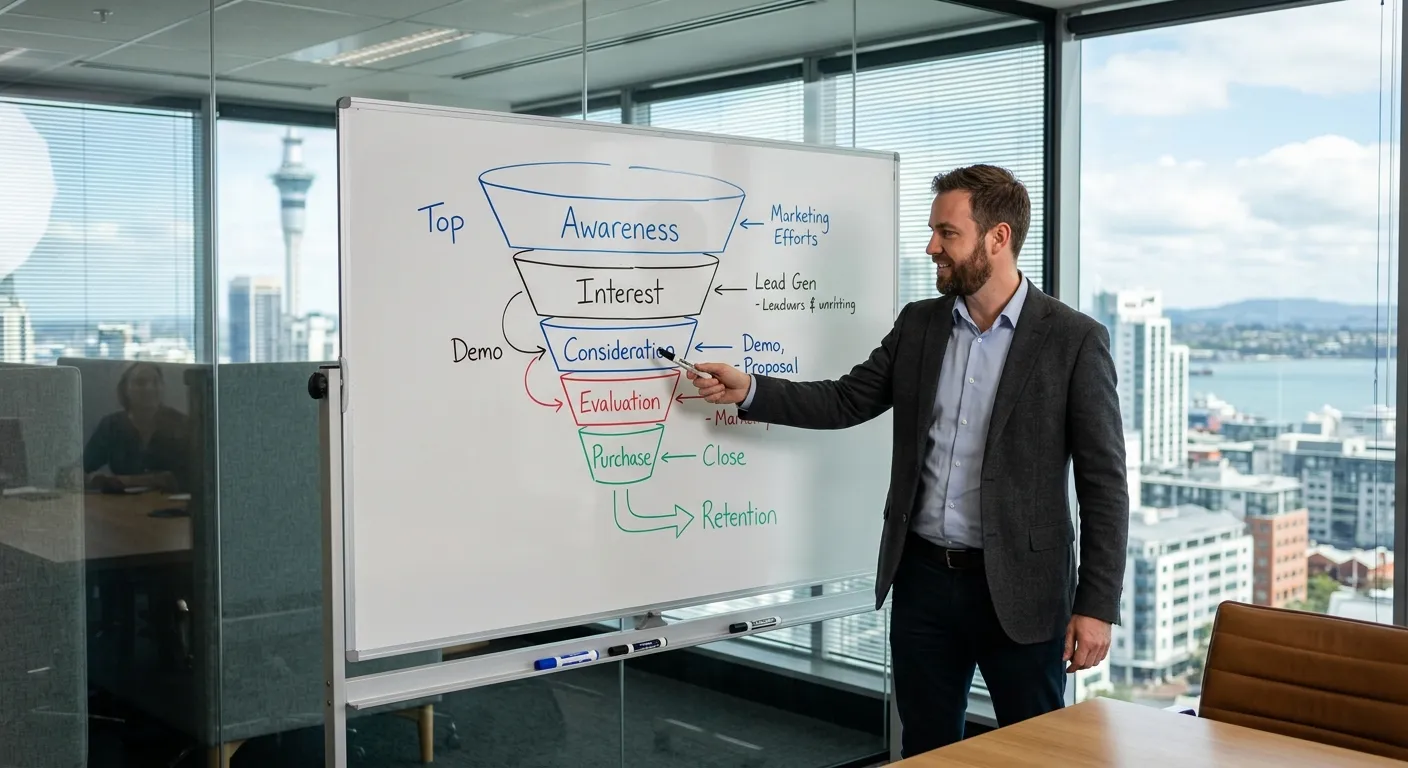
Most NZ business owners I speak to are overwhelmed by funnel advice. Should you run a webinar? A book funnel? A squeeze page? A quiz? What about an upsell sequence? The answer for small to medium service businesses in New Zealand is almost always “none of the above, until one specific thing is working.”
This post covers the sales funnels Lucid Media has actually built and measured for NZ clients over the last five years. Real examples, real numbers, and an honest take on which ones are worth building in 2026 and which ones are a waste of time.
How I rank funnels for NZ service businesses
Five criteria I use on every new client engagement:
- Lead volume: how many qualified leads can this realistically produce per month?
- Implementation time: how long before it’s live and collecting leads?
- Ad spend requirement: what’s the minimum monthly paid media budget to make it work?
- Ongoing effort: does it run itself or does it need weekly attention?
- Content required: can you stand it up with existing assets or does it need a production team?
A funnel that scores well on all five is one we build for clients. A funnel that scores poorly on even two gets cut from the proposal.
Tier 1: build these first
1. The Quiz / Assessment funnel
This is the highest-converting funnel we run for NZ service businesses, full stop. If you have a service where the prospect’s situation affects what they need, you should have a quiz funnel.
How it works: The prospect answers 6 to 12 questions about their current situation. The quiz computes a score or classification. They enter their contact details to see their personalised result. You get a warm lead who is already qualified.
Real Lucid client example: We built a mortgage readiness quiz for Fundmaster, a NZ mortgage adviser. Eight questions covering current situation, deposit status, income, timeframe. The result page shows them where they sit on the readiness scale with specific next steps. Combined with paid Meta traffic, this funnel generated a high-volume pipeline of qualified leads in four months at a cost per lead roughly 40% lower than any other funnel we had tested for them.
Why it works: The prospect is getting something genuinely useful (a clear answer about their situation) in exchange for their details. The quiz itself pre-qualifies them, so the leads that come through are not cold email-harvest leads, they are people who actually need the service.
Investment: Moderate. Quiz software costs around $30 to $100 a month. The strategic work is writing the questions and the result logic, which takes 10 to 20 hours of planning.
Who should use this: Mortgage advisers, financial planners, accountants, business coaches, trades businesses where the job scope varies significantly, and any professional service where prospects have very different needs.
2. Lead magnet funnel to email nurture
The cleanest, most reliable funnel we build. Works for almost any service business.
How it works: A free resource (checklist, guide, template, calculator) in exchange for an email address. The prospect then enters a 5 to 7 email nurture sequence that builds trust and pitches your service at the right moments.
Real Lucid client example: For our own free strategy call offer we put a free website audit lead magnet at the top of the funnel. Prospects get a 24-hour personalised Loom video walkthrough of their site. Close to 10% of prospects who fill in the form convert to a booked strategy call. I cover the full build of this funnel, including the email sequence structure we use, in our lead magnet funnel guide.
Why it works: The lead magnet filters for intent. The email sequence does the patient work of converting them when they are ready, which could be a day or six months.
Investment: Low to moderate. The lead magnet itself is the biggest time cost. Tools like Mailchimp, Resend, or Zoho Campaigns are 10 to 40 dollars a month.
Who should use this: Any service business with a sales cycle longer than a week.
3. Google Business Profile to phone-call funnel
The most underrated funnel for local trades and service businesses. Most agencies will not even call this a funnel. It is.
How it works: Prospect searches on Google for your service in their area. Your Google Business Profile appears in the local pack with reviews, photos, and a call button. They tap call. You answer.
Real Lucid client example: We took on a NZ plumbing client whose GBP had 14 reviews and a 3.8 star rating. We built a review-request system into their job-completion workflow and optimised the profile properly: full category list, service list with pricing, weekly photos, review responses within 24 hours. Twelve months later they have 160 plus Google reviews, sit top 3 in local pack for their service area, and GBP is now their largest lead source. Zero paid ads. Zero complex funnel. Just proper GBP plus a review engine.
Why it works: Prospects searching “plumber [suburb]” are at the bottom of the funnel already. They want to book now. The only friction left is trust, which reviews handle.
Investment: Zero cost. Just time and discipline on review requests.
Who should use this: Every local service business. Electricians, plumbers, gardeners, roofers, cleaners, mechanics, window cleaners, painters.
Tier 2: build these once Tier 1 is working
4. The VSL (Video Sales Letter) funnel
A VSL funnel is a single long-form video pitch, usually 8 to 15 minutes, that walks a prospect from curious to booked.
How it works: Prospect lands on a page, clicks play, enters contact details to continue watching. The video tells the story of who you help, how you help them, what the process looks like, and what happens next. They book a call at the end.
Real Lucid context: We built our own VSL funnel at lucidmedia.co.nz to sell the Lucid Launch System. It runs on top of paid Meta traffic. It is not our best lead source (the audit funnel is), but it produces higher-intent leads who arrive at the strategy call already half-convinced.
Why it works: A VSL can sell a more complex or higher-ticket service than a lead magnet can. Ten minutes of video carries more persuasive weight than a three-paragraph landing page.
Investment: Moderate to high. The video production itself is the investment. A good VSL costs 2,000 to 10,000 NZD to script, shoot, and edit properly, depending on quality.
Who should use this: Service businesses selling an engagement above 5,000 NZD per client, where you need the prospect to understand more than the basics before they book.
5. Retargeting sequence funnel
The “why do I keep seeing this company everywhere” funnel. Works well, but requires paid media budget to be worth building.
How it works: Run broad awareness ads to cold traffic. Track who engages. Retarget engaged prospects with a sequence of progressively more specific ads. Warm them up before pitching.
Real Lucid client example: We built this for TSB Living across their e-commerce catalogue. Cold traffic sees broad brand ads. Anyone who clicks through gets retargeted with specific product ads. Anyone who adds to cart but does not check out gets a third layer with a discount. The retargeting layers lifted overall return on ad spend by 2x compared to running a single campaign.
Why it works: Most people do not buy on first exposure. The retargeting sequence closes the loop on the 95% of cold traffic that would otherwise disappear.
Investment: You need a minimum 2,000 NZD a month in paid media for this to produce enough data to optimise. Below that, the algorithm does not have enough volume to work with.
Who should use this: E-commerce businesses and service businesses already spending on paid Meta or Google.
Tier 3: works in specific situations
6. Webinar / Masterclass funnel
Works, but only if you already have an audience to fill the webinar. If you do not, the funnel upstream (getting people to register) is harder than the webinar itself.
When to use it: You are selling a service above 10,000 NZD per client, your audience is already warm (existing email list, social following, or referral base), and you have the presence to hold attention for 45 minutes.
When to skip it: You are trying to generate leads from cold traffic. The cost to fill a webinar from cold almost never pencils.
7. YouTube content to VSL funnel
Works if you are already committed to weekly YouTube content. Works brilliantly in that case. Does not work as a “let me start YouTube” project.
Why: You need a library of videos (usually 20 plus) before YouTube funnels your viewers in meaningful volume. Most NZ service businesses will not sustain that consistency.
Funnels I would not recommend in 2026
- Book funnels. Expensive to produce. Reach the wrong audience (book buyers, not service buyers).
- Challenge / 5-day launch funnels. Work for info products, not for local service businesses.
- Tripwire / low-ticket offer funnels. Require huge volume to pencil. Not worth it for a local plumber or mortgage adviser.
- Community / group funnels. Labour intensive. The community becomes a full time job, not a sales channel.
The sequence I would run today
If I were starting a NZ service business from zero, here is the order I would build funnels in:
- Google Business Profile plus a review request system. Free. Live in 2 weeks.
- Quiz or lead-magnet funnel with a 5-email nurture. 3 to 4 weeks to build.
- Once the first two are producing 30 plus leads a month, layer on a retargeting sequence.
- Once the business is doing 20,000 plus NZD a month in revenue, build a VSL.
- Only after all four are working do I consider a webinar or YouTube funnel.
The mistake I see most often is a business owner trying to build funnels 4 and 5 before funnels 1 and 2 exist. Every time.
If you want me to look at your current funnel and tell you which of these you should be running, book a 30 minute strategy call. I review your current setup live on the call and give you a specific order of operations. No pitch deck, no obligation.
FAQs
How much does it cost to build a sales funnel in NZ?
A simple lead magnet funnel with email nurture can be built for 2,000 to 5,000 NZD. A quiz funnel costs 4,000 to 10,000 NZD depending on complexity. A VSL funnel with professional video production runs 8,000 to 20,000 NZD. These are one-off build costs. Ongoing management and paid media are separate.
What is the best funnel for a local trades business?
Google Business Profile first, a review system second, then a lead magnet funnel. You almost never need anything more sophisticated than that.
How long before a funnel produces leads?
A properly built quiz or lead magnet funnel starts generating leads in week one. Retargeting funnels need 4 to 8 weeks of data before they are optimised. VSL funnels often need 6 to 12 weeks to dial in.
Do I need a sales team to run these funnels?
For bottom-tier funnels (GBP, lead magnets), no. Email nurture handles the follow-up. For higher-tier funnels (VSL, webinar), you need at least one person who can take discovery calls. The funnel produces the lead. A human still closes the sale.
Which funnel has the highest conversion rate?
Quiz funnels typically see 20 to 40% of quiz completers converting to booked calls. GBP-to-phone-call converts higher than any funnel on this list, but only for prospects already searching in-market.

Written by
Jason Poonia
Jason Poonia is the founder and Managing Director of Lucid Media, helping NZ businesses grow online since 2018. With over 6 years delivering results for clients across New Zealand and internationally, Jason combines technical expertise with proven marketing strategies to help businesses attract more customers and build scalable systems. Background in Computer Science from the University of Auckland.