
Google March and April 2026 Core Updates: Why Your Traffic Dropped
Two Google core updates back to back. March hit AI content hard, April rebuilt the ranking signals. Here is what changed, who got hit, and how to recover.
Key Takeaways
- Two core updates rolled back to back. The March 2026 Core Update ran from 27 March to 8 April. The April 2026 Core Update started rolling out within days of the previous one finishing.
- Sites that scaled AI-generated content got hit hardest. Reddit reports of 80% traffic drops for generic AI content sites are not exaggerated. We have seen the same on accounts we audited.
- YMYL categories took the heaviest blow. Health, finance, legal, and local service sites in those categories saw 20 to 35 percent ranking drops if their content lacked first-hand experience signals.
- Information gain is the new signal that matters most. Google is rewarding pages that add something the rest of the web does not already have. Recycled summaries are being demoted.
- Recovery takes three to six months, not weeks. Most of what you read online about quick fixes is wrong. Google needs to recrawl and re-evaluate.
- For NZ and Australian businesses, the local angle is real. Sites with first-hand local data, real case studies, and verified author credentials outperformed generic content even more sharply than usual.
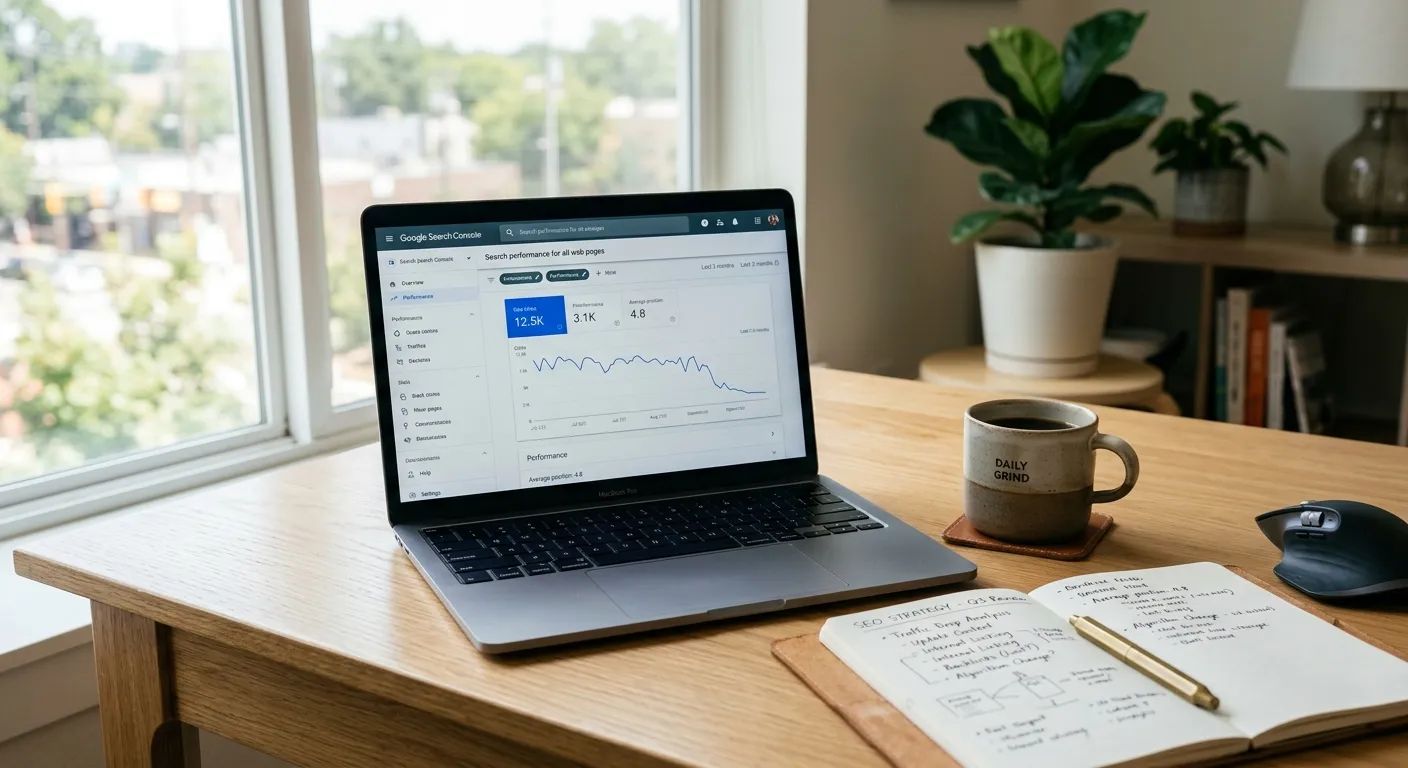
If your Google Search Console started bleeding clicks in late March or April 2026, you are part of a very large club. Reddit’s r/digital_marketing, r/SEO, and r/SaaS have been a steady stream of “what just happened to my traffic” threads since 27 March. The answer is two of the most disruptive core updates Google has shipped in years, running back to back, with very little gap between them.
This is the SEO half of a one-two punch we are calling “what broke in March 2026”. The other half was Meta’s attribution rebuild, which hit paid advertisers in roughly the same window. If your reporting collapsed across both Google organic and Meta paid in March or April, you are not unlucky. The platforms changed under you simultaneously.
This post walks through the actual timeline, what changed, who got hit, and what to do now.
The actual timeline
Three discrete updates landed inside fifteen days, which is part of why the volatility felt so extreme.
- 24 to 25 March 2026: Google March 2026 Spam Update rolls out.
- 27 March 2026: March 2026 Core Update begins rolling out.
- 8 April 2026: March Core Update completes its rollout, 12 days and 4 hours after launch.
- Mid-April 2026: April 2026 Core Update begins rolling out within days of the previous update finishing.
For most webmasters, the March spam update and core update felt like a single 16-day event. The April update on top of that meant five to six weeks of constant ranking volatility. SE Ranking and other tracking tools recorded more volatility than December 2025, which itself was a heavy update. Over 55 percent of sites tracked saw measurable ranking shifts.
March 2026 Core Update: the AI content reckoning
The March 2026 Core Update is the one most people are blaming for the traffic drop, and they are mostly right.
Google’s stated framing was the usual “regular update intended to better surface relevant, satisfying content from all types of sites”. The data tells a more specific story. Sites that scaled AI-generated content for the SEO play saw the heaviest losses. The pattern across accounts we audited:
- Programmatic SEO sites with thin AI content: 60 to 80 percent traffic drops.
- Affiliate sites with rewritten product comparisons: 40 to 60 percent drops.
- SaaS blogs that scaled AI content for keyword coverage: 30 to 50 percent drops on the AI-heavy content, 0 to 10 percent on human-written content on the same domain.
- Local service sites with original first-hand content: 0 to 15 percent movement, often slightly positive.
The pattern is consistent enough that you can almost predict the impact by how much of a site’s content was AI-generated and how much first-hand experience it carried.
This is not Google “penalising AI content” the way the headlines often frame it. Google is penalising scaled content abuse: pages that exist to capture search traffic without adding anything new to the conversation. A human writer who pumps out 200 thin posts a year would have been hit by the same update. AI just made the scaling easier, which made the problem more visible.
April 2026 Core Update: shifting toward evidence
The April update rolled in before the March one had even finished settling. Where March was about content scale and originality, April pushed harder on the signal side.
Three trends are visible in the data so far.
Information gain is now a primary signal. Google has been talking about information gain as a ranking concept for two years. The April update appears to be the version where it actually moves rankings at scale. Pages that say what every other top-10 page already says are being demoted. Pages that add a unique angle, a piece of original data, or a first-hand experience are being lifted.
E-E-A-T moved from concept to enforcement. Experience, Expertise, Authoritativeness, and Trustworthiness were always guidelines, but Google’s confirmed author signals now appear to weight rankings on YMYL queries far more heavily. If you write about health, finance, law, or anything that affects someone’s wellbeing, the byline matters now in a way it did not in 2024.
AI Overviews are eating the click. Google’s AI Overviews are appearing on more queries and resolving more of them in the SERP itself. For informational queries especially, sites are losing clicks not because they ranked lower but because Google answered the question without sending the user through. This is structural, not algorithmic. The post-April recovery playbook has to account for it.
Who got hit hardest
The pain was not evenly distributed. From our analysis of client accounts and the broader Reddit and SEO Twitter chatter:
Hit hardest:
- Programmatic SEO sites built on AI templates
- Affiliate review sites with thin or rewritten content
- SaaS marketing sites with AI-scaled blog programs
- YMYL sites without verified author credentials
- Sites with shallow topical coverage (one or two posts on a topic)
- Sites with bot-friendly content but weak brand signals
Held steady or improved:
- Sites with original data and first-hand experience
- Strong brand sites with branded search demand
- Sites with deep topical clusters and verified author credentials
- Local service sites with real reviews, photos, and case studies
- Niche communities and forums with genuine user content
- Sites with structured data and clear E-E-A-T signals
The dividing line was not “AI used vs not used”. The dividing line was “content adds something to the web vs not”. AI is a fine tool to use as part of your process. Pure AI scaling without a human in the loop is the practice that got punished.
Information gain in plain English
Information gain is the concept that a page should add something the rest of the web does not already have. Google has been experimenting with how to measure it for years. The April 2026 update is the version where it appears to work well enough to move rankings.
A few practical examples of how to add information gain:
- Original data. Run a survey, audit a sample of accounts, run a controlled test, and report the numbers. We did this with our Google Ads vs Facebook Ads for NZ service businesses post and it has held its rankings through both updates.
- First-hand case studies. Real campaigns, real numbers, real outcomes. Stock photos and generic frameworks do not count.
- Unique angles. If everyone is writing the “what is X” post, write the “when X is the wrong answer” post. Different framing, different value.
- Lived experience. A doctor writing about diabetes care from clinical practice will outrank a content farm writing about diabetes care from research. The April update made this gap wider.
- Synthesis at depth. Pulling together five disparate sources into a coherent argument that none of them made on their own. This is hard to do well. It also ranks well.
If a future reader could get the same information from any other top-10 page on your topic, you are not adding information gain. That page is now at risk.
What recovery actually looks like
The honest answer is that recovery from a core update takes three to six months, not three to six weeks. Anyone telling you otherwise is selling you something.
Google’s recovery cycle works like this:
- You make changes. Updated content, new pages, removed thin content, new author signals.
- Google recrawls. Depends on your crawl budget. New or low-authority pages can take weeks to recrawl.
- Google re-evaluates. Algorithmic decisions about content quality are made over rolling windows, not on a single crawl.
- The next core update lands. Often the biggest recovery moments come at the next core update, not before.
If you got hit in March, expect meaningful recovery to land somewhere between June and October 2026, depending on the depth of your changes and how quickly Google recrawls your site. Some pages may not recover at all if they were thin to begin with.
Do not delete pages in a panic. Do not no-index everything. Do not rewrite all your content with AI to “fix” it (that just digs the hole deeper). The recovery playbook is slower and more thoughtful than most people want it to be.
A practical recovery checklist
Work through this in order. Skip nothing.
- Identify the bleed. In Search Console, compare the 30 days before 27 March against the 30 days after 8 April. Sort pages by clicks lost, not percentage drop. Focus on the 20 pages that lost the most absolute clicks.
- Categorise each lost page. AI-generated, lightly edited, fully human, mixed? Original or recycled? First-hand or research-only? You will see a pattern within ten minutes.
- Decide page by page: improve, consolidate, or remove. Thin pages with no recovery path should be either redirected to a stronger page or removed entirely. Pages with recovery potential should be rewritten with first-hand input.
- Improve top pages first. Inject original data, lived experience, real examples, screenshots from your own work. Add a real author byline with credentials and a link to a real bio.
- Tighten your topical clusters. A site with three deep clusters covering one topic well will outperform a site with thirty shallow clusters covering thirty topics poorly. Now more than ever.
- Audit your E-E-A-T signals. Author bios, schema markup, real photos of real people, links to professional credentials, links between authors and their content.
- Strengthen your brand. Branded search demand is a defensive moat. If people search for your name and not just keywords, you are far more resilient to core updates. Invest in PR, social, and direct marketing alongside SEO.
- Build internal linking depth. Topical authority is partly about how your pages link to each other and how clearly the relationships are structured.
- Wait. Do step ten before step nine if you can.
- Measure at the next core update. Do not panic on weekly Search Console data. Measure recovery on monthly trends and core update boundaries.
If you want to move faster on the audit step, you can point Claude or another AI tool at your Search Console data and have it categorise pages and surface patterns much faster than doing it manually. The same MCP-style integrations that exist for Meta Ads now exist for Google Search Console and Google Analytics.
What this means for NZ and Australian businesses
A few specifics for the ANZ market.
Local-first content held up better. NZ and Australian sites that lean into local case studies, local data, and locally relevant examples saw less impact than US-style generic content. The April update appears to weight local relevance signals more strongly.
Smaller markets have less SERP redundancy. A “best plumber in Auckland” page does not compete with a thousand other thin pages the way “best plumber in Los Angeles” does. NZ-focused content with original local data has a relatively stronger position post-update.
The AI content tactic was less common here to begin with. Many NZ and AU agencies were behind US agencies on programmatic AI SEO, which means many local sites were not exposed to the worst of the March downside. That is one rare case where lagging was protective.
Recovery resources are thinner locally. Most of the SEO advice in market right now is from US sources. We are seeing NZ and AU businesses spend money on US recovery consultants who do not understand the local search landscape. If you are recovering, work with someone who understands your market.
If you are running paid ads alongside SEO and your reports look weird across both, the Meta March 2026 attribution rebuild post covers the paid side of the same disruption.
What we are doing differently for clients
Three concrete shifts in our process post-update.
1. Original data on every pillar piece. Every cornerstone post we publish for a client now carries at least one piece of original data, an original case study, or a survey we ran ourselves. This was a “nice to have” before March. It is non-negotiable now.
2. Author signals on YMYL. Every YMYL post (anything in finance, legal, health, or business critical decisions) now ships with a real byline, a real bio, schema markup, and a link to verifiable credentials. Most sites still do not do this properly.
3. Less, deeper. We are publishing fewer posts per client per month and spending the time on depth instead. A 3000-word post with original data and lived experience outperforms five 800-word posts every time, especially after this update.
The shorthand version: less AI content, more first-hand expertise, slower cadence, deeper coverage.
Frequently asked questions
When did the March 2026 Google Core Update roll out? The March 2026 Core Update began rolling out on 27 March 2026 and finished on 8 April 2026. It ran for 12 days and 4 hours, just after the March 2026 Spam Update which rolled out 24 to 25 March.
When did the April 2026 Google Core Update roll out? The April 2026 Core Update began rolling out within days of the March update completing on 8 April. The two updates back to back is a major reason advertisers and SEOs have been seeing extreme volatility through April and into early May.
Did Google penalise AI content in the March 2026 update? Not exactly. Google penalised scaled content abuse, which often looked like AI-generated mass content but is the same problem when it is generated at scale by humans. Sites that used AI as part of a thoughtful editorial process with first-hand experience layered in were largely unaffected. Sites that scaled thin AI content for keyword coverage took heavy losses.
How long does recovery from a Google core update take? Three to six months for meaningful recovery, sometimes longer. Google’s recrawl cycle, re-evaluation cycle, and the cadence of subsequent core updates all gate the speed of recovery. Quick fixes within weeks are usually noise, not real recovery.
Should I delete the pages that got hit? Mostly no. Audit each page, decide whether to improve, consolidate, or remove. Wholesale deletion can hurt your overall site quality signals if you remove too much at once. Improve pages with recovery potential, redirect pages that overlap with stronger ones, and only remove pages that have no path forward.
Did the March or April 2026 update affect local SEO? Yes. Local service sites with weak first-hand content (generic service descriptions, stock photos, no real case studies) lost ground. Local sites with real reviews, real photos, real case studies, and verified business signals held up well or improved. The local pack itself was less volatile than organic results.
Is it still worth investing in SEO after these updates? Yes, more than ever for businesses that can produce real expertise. The bar for ranking just rose, which is bad news for content farms and good news for businesses with genuine knowledge to share. If you have lived experience in your industry, the post-April SEO landscape rewards you more, not less.
Where to from here
The March and April 2026 core updates are the most disruptive SEO events since the Helpful Content Update in 2022. They are not the end of SEO. They are the end of a particular flavour of SEO that relied on scaling content without substance.
If your traffic is down and you are unsure whether to recover, replace, or rebuild, book a call with our team. We work with NZ and AU businesses on SEO strategy, content quality audits, and recovery planning grounded in the local market.
The bar moved. Stand on the higher one.
Related posts

Written by
Jason Poonia
Jason Poonia is the founder and Managing Director of Lucid Media, helping NZ businesses grow online since 2018. With over 6 years delivering results for clients across New Zealand and internationally, Jason combines technical expertise with proven marketing strategies to help businesses attract more customers and build scalable systems. Background in Computer Science from the University of Auckland.